

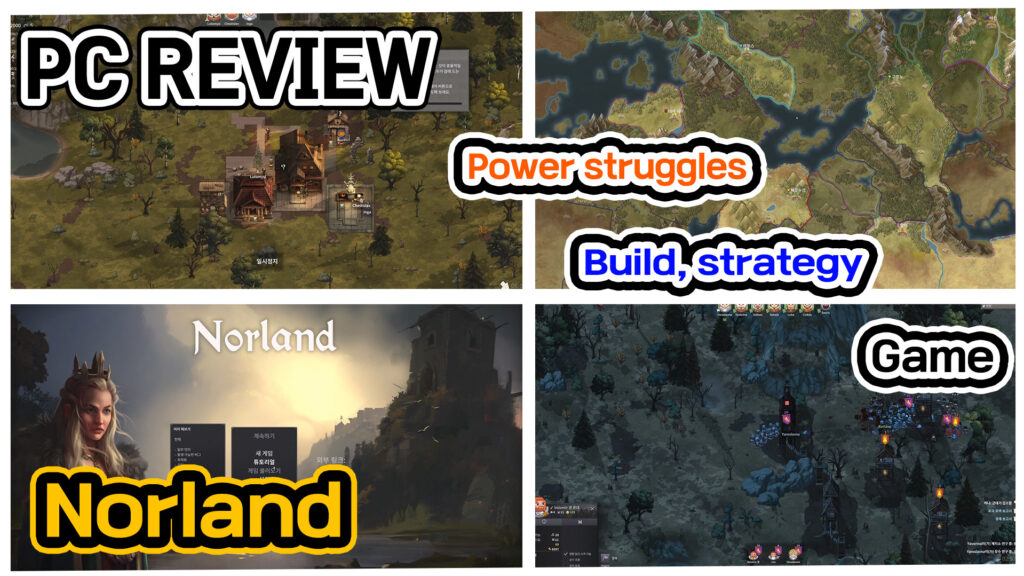

This review is an AI translation of the original Korean post. Proper nouns, and some game titles and expressions, may differ.
1. ‘Norland’ Overview
I was looking for a game I could play lightly, one that looked fun, and the game I landed on was ‘Norland’. It is still in Early Access. The gameplay video on the Steam page caught my interest, so I bought the game.
The graphic textures are a style I like, the movement is smooth, and it has a charming, intricate feel, so I chose it. The genre can be taken as construction, management, strategy, and tactics. Similar games that came to mind, among the ones I have reviewed, were ‘[PC Game Review] RimWorld‘, ‘[Classic PC Game Review] Knights of Honor‘ came to mind.

In the parts where, as a lord, you have a wife, have children, pass on the throne, and manage and rule the fief through various nobles, I felt the earlier ‘Knights of Honor’. The resemblance is slight in construction and management, but entering battle on the map and trading brought ‘RimWorld’ to mind.
As for the Korean localization, I did not find any part that was a serious problem while playing. I think I saw a section left in code about once, but when I watched the footage I recorded while playing again, it was so hard to find that I do not think you need to worry about the translation. Character names are in English, though, so they can be a bit confusing.

I cannot say the bugs are few. I cannot say there are none. They are definitely there. During screen transitions, or in parts that draw heavily on resources, the game sometimes crashes and shuts down, perhaps from the workload.
Even so, there is an autosave system and you can adjust the speed in-game, so although the flow getting cut can leave you a bit deflated at times, it looks like it needs improvement.

2. ‘Norland’ Review
2.1. Features
Once you learn from the tutorial at the start, this is a game you can play without much difficulty. It is not so complex that there is a barrier, and play is not so hands-on or complicated that it is hard.

You can adjust the speed and pause whenever you want, so I think you can progress according to your skill. The AI carries out work efficiently, so there is no need to control things by hand. Assign workers to buildings and set the work going, and resources gather on their own and growth is smooth.
Whatever else, the most important thing is the noble factions. The knowledge they learn in the library becomes the fief’s knowledge, so you can construct buildings, obtain resources, and earn money.

If the noble who knows that knowledge dies, the technology is forgotten as time passes, and if no noble remains who has studied and remembers that knowledge, you can no longer gain the stats tied to that technology or construct the buildings. I felt this was a truly unique system.
Notably, iron, which is absolutely essential for combat, is limited as an iron ore resource, so in the later stages you can obtain it only through trade. In practice, to maintain a large army, you seem to have no choice but to rely on the weapons of the merchants provided by the religious authority.

Through relations with lords and relations among the nobles inside, people sometimes die and various penalties come up depending on the case, but to me it did not come across as content that greatly decides success or failure.
You could say the direction it steers you is a bit lacking. That may be because I did not set the difficulty high, so I was in a position where I did not have to pour effort into those elements.

There are elements such as recruiting an opposing noble, poisoning them, or winning them over, but somehow I never reached for them. More troops! More troops! That is what I would say.
I judge that bandits spawn in the fief on a set interval, and on the defense they are quite strong, so once they have formed a certain size, subjugating them became quite a burden.

The counter, such as it was, is that they invade the fief on their own. I played by subduing the ones who came charging in at that time, then pushing into the bandit camp afterward once their numbers had dropped.
When a lord or the nobles grow old, their stats can fall, and even if you spend a long time raising their stats, they can die of old age or in an accident. Because effort can vanish in many ways, I did not play boldly and progressed in a stable way.

2.2. Graphics and Sound
As I mentioned earlier in the overview, what drew me to this game is that the graphics feel like an indie game but are truly clean, and in the video the optimization also looked well done.
I could see a trade system, and with these charming graphics there was a look of large-scale battles, so I wondered if this was a god-tier game where you grow a fief and also fight. The graphics are definitely clean, and when you zoom in I do not want to talk that quality down.

As the elements increase, though, whether it is eating computer resources or something gets tangled, I cannot tell, but sometimes the game suddenly freezes or shuts down. Even so, for the graphics I really want to give a good score.
For the sound as well, the murmur of crowds, the sound of arrows flying in and lodging during battle, the background music, and the sound effects are fitting, and I did not feel anything largely off. The sound of the act of leaving descendants for the next generation is depicted a little too well, to the point of being embarrassing.

The game’s cutscenes also show images with a watercolor feel, and there is narration, so I want to give them a good score.
2.3. Difficulty
I played the game through the tutorial. I kept going until the ending, and aside from crashes while playing, it was a difficulty where I never felt stuck enough that I would need to look up a guide.
Even so, as I went on there were often parts that were not easy to understand, and I went through trial and error while testing this and that, but I could make progress. It did not flow like water, but I would say it was a difficulty where you can find a way through trial and error and move forward.

It may differ with the difficulty setting, but if I let my attention slip, our nobles would suddenly disappear, or they would duel and then die. Even so, if I earned plenty of money through trade and shared camaraderie (?) through building favor and hunting, there was no problem.
In combat, if you are not equipped, collapsing quite miserably is commonplace, so it matters that you gear up properly. Ranged units stationed in the towers are truly lethal, to the point that they limit a perfect victory. It is rough to see them take more arrows than you expect and drop one after another.

When it comes to growing the population, once you reach a certain level the game says there are too many people, and you gradually close in on the cap. They seem to have put in a fitting system. The disappointing part is that you cannot develop the fief enough to fill the map.
To do that, though, the computer’s resources probably would not hold. By the later stages, considerable stuttering from the resource load could be seen inside the fief.

2.4. Play Time
My total play time was 22.9 hours. I did see the ending on the tutorial setting, but I wonder whether I need to change the game settings and play further.
As I see it, there seem to be 2 main paths to clearing the game. If, as I played, you place the other lords beneath you and come to hold more than a certain amount of territory, a final quest (?) appears, and you clear the game through that.

The other way looks peaceful (?). I did not play that way, so I am not sure, but from wording such as free trade I judge it to be a method of forming alliances.
Once you launch the game and start playing, the immersion is considerable. There is fun in gathering resources, growing the fief, and strengthening military power. As I said earlier, though, what breaks the immersion is the game suddenly shutting down from an internal crash.

I think it is that way because it is still an Early Access game, but a problem is a problem.
As for addictiveness, immersion and addictiveness alike, toward the later stages, start to feel like you take your hands off, as is typical of these games about taking fiefs. With too much information, you focus only on the important parts, and the stability of play drops.

Anyway, the further into the late game I went, there were optimization problems as well, and immersion and addictiveness dropped a bit. I could not help thinking, deep down, that I wanted to finish the scenario and be done with the game.
3. ‘Norland’ Closing
The graphics are charming, and most of the content is not, but it is a game with the fun (?) of growing a fief and of training (?) and raising the lord and the nobles under the lord. Combat is fun when you win, and when warriors die your heart sinks for a moment, but it is good.

As I write this, I sometimes think of raising the difficulty and playing the game in a direction different from the one I took, and I think that if I do play, I would probably play for 20 hours.
In many ways the game seems to have been made user-friendly and well put together. The evidence would be that nothing in play felt excessively irritating or frustrating.

It is still an Early Access game, but I judge it to be quite well made. Play time is short relative to the price, but if it leads you into a different kind of play, and I do not know whether there is a different closing cutscene, but if it tells you one exists and draws the player into a 2nd run, I judge it to be a game that yields enough play time.
On that basis, I judge the price would also be at an acceptable level. For me it was a game I could enjoy, and if you can put up with the game shutting down from bugs, I think it is worth playing.

Thank you. I wish you good luck on the road ahead. Thank you.